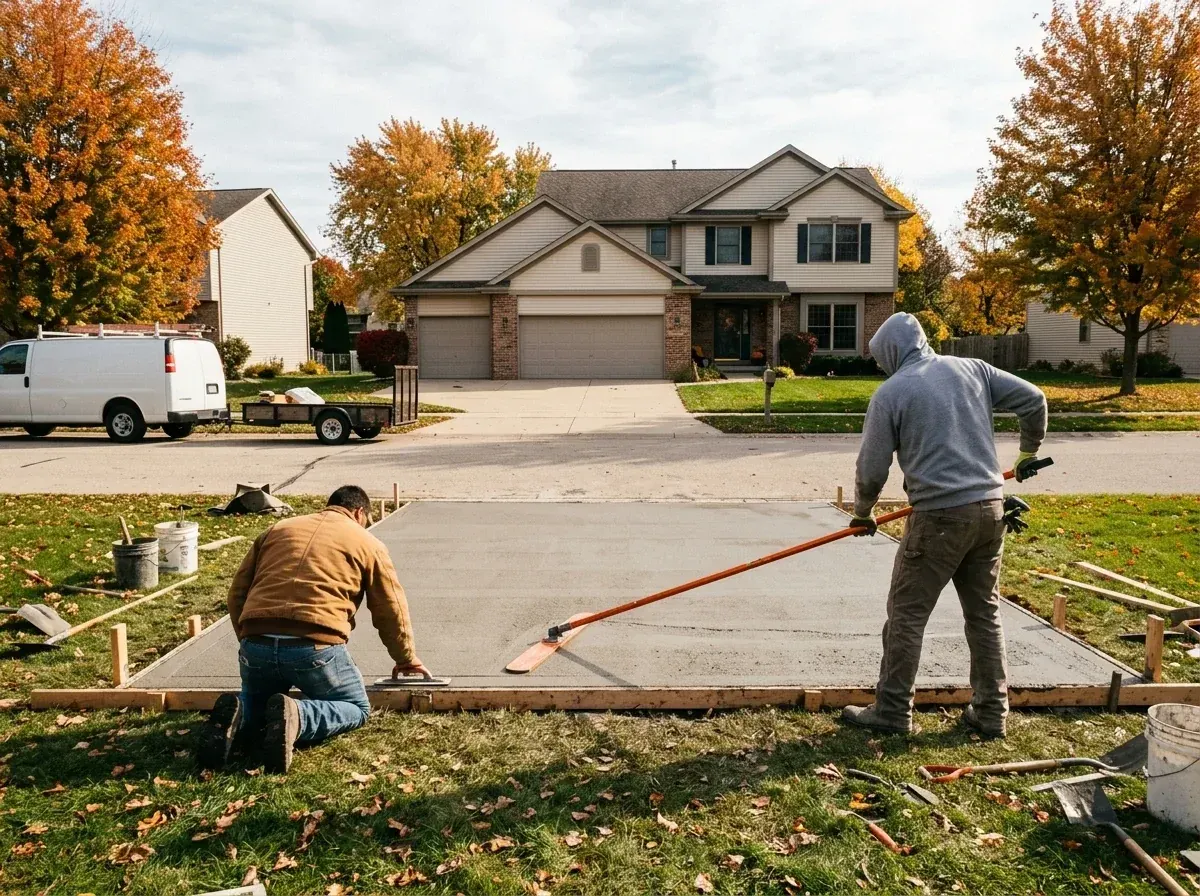
Wisconsin footing depth rules for stoops and foundations
One statewide rule sets footing depth. Under SPS 321.16(1)(a), footings and foundations, including those for landings and stoops, go below the frost penetration level or at least 48 inches below adjacent grade, whichever is deeper.[1] Wisconsin publishes no county frost-depth table, so 48 inches is the figure everywhere in the state.[1]
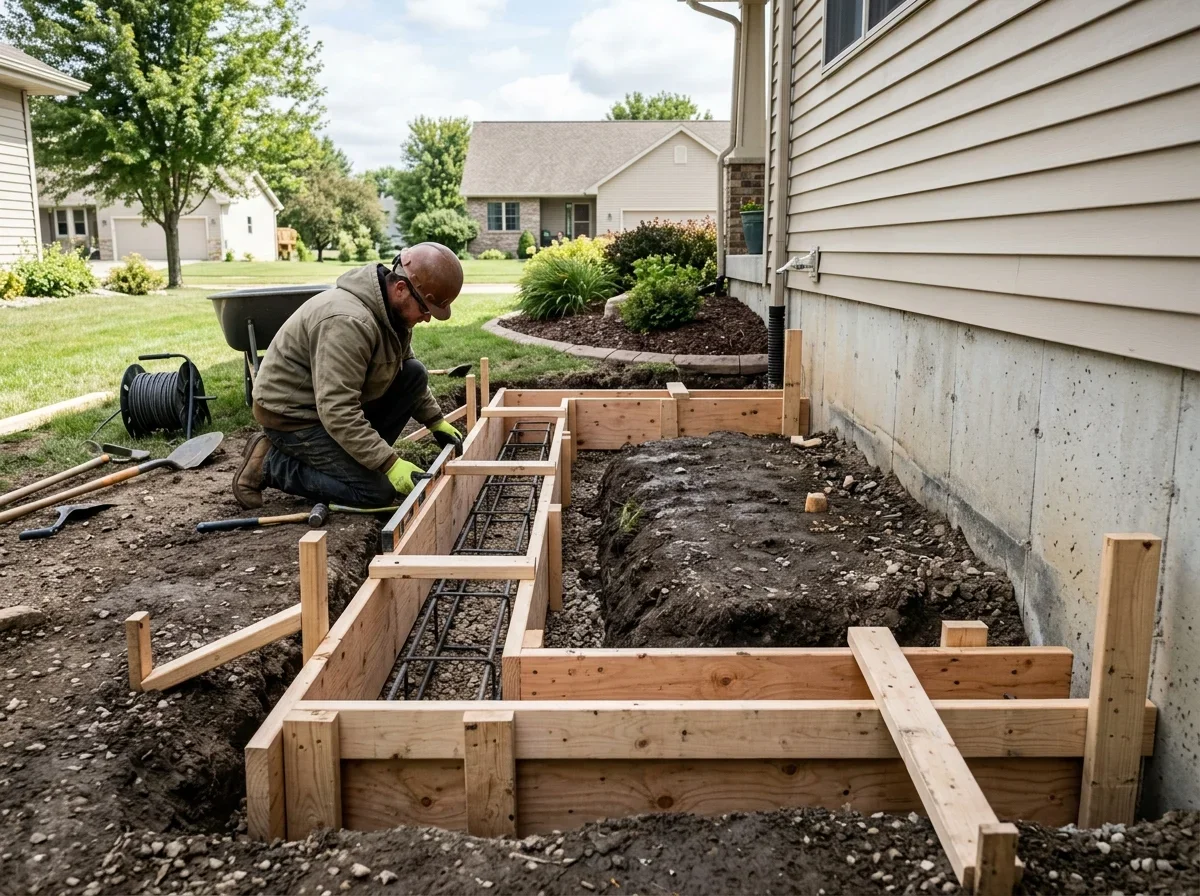
A local inspector can ask for more than the minimum.
Ask the building inspector before you dig rather than relying on a number from a forum. Homeowner advice on footing depth ranges widely. Our frost depth guide covers the rule in more detail.
If the stoop attaches to a deck, the Wisconsin deck code guide covers the footing side of that project.
Bedrock and frozen ground
Two other parts of the rule matter to a homeowner. Footings may not be placed on frozen material.[1]
That affects when a pour can be scheduled.
Side by side
Footing on soil versus on bedrock
On soil
- At least 48 inches below adjacent grade
- Or below frost penetration, whichever is deeper
- Never on frozen material
On bedrock
- Rock cleaned of all earth
- Crevice clay removed
- Water kept from collecting along the foundation
Footings may bear directly on bedrock less than 48 inches below grade only under three conditions:[1]
- The rock is cleaned of all earth.
- Clay in crevices is removed to the level of frost penetration or 1.5 times the crevice width, whichever is less.
- Provisions prevent water from collecting along the foundation.
Permit rules for driveways and flatwork by Wisconsin city
The answer varies city by city. Among the 30 largest cities by Census Bureau Vintage 2025 population estimates[2], the results as of October 2026 are:
- Yes (5 cities): Madison, Green Bay, Oak Creek, Stevens Point and Muskego.
- Depends (8 cities): Appleton, Eau Claire, Waukesha, Oshkosh, Fond du Lac, New Berlin, Franklin and Superior.
- No (0 cities): none of the 30 is confirmed as a flat "no."
- Unknown (17 cities): including Milwaukee, Kenosha, Racine, La Crosse and Neenah.
An unknown means the city's pages did not settle the question. It does not mean no permit is needed.
| Answer | Cities | Examples |
|---|---|---|
| Yes | 5 | Madison, Green Bay, Oak Creek |
| Depends | 8 | Appleton, Waukesha, Oshkosh |
| No | 0 | None confirmed |
| Unknown | 17 | Milwaukee, Kenosha, Racine |
For those 17, check with the city and use the city page in our permit table. For example, see Racine or Neenah.
Why "depends" is common
A "depends" usually reflects the details of the job. Local rules can differ for work inside the public right-of-way versus work on the private lot. The Town of Algoma says driveway work outside the right-of-way may not need a town permit, while a new residential driveway in the right-of-way does.[6]
Shoreland adds another layer.
Patios, sidewalks or driveways within 75 feet of the ordinary high-water mark may need county authorization.[6]
When you call, ask separate questions rather than one general one:
- Does the job need a building permit?
- Does it need zoning approval?
- Does a driveway or right-of-way permit apply?
- Is a county or shoreland permit involved?
Describe the job precisely: replacing a slab in place, widening it, or building new.
For cities with a confirmed "yes," see Madison and Oak Creek. For cities with a "depends," see Waukesha, Oshkosh and Fond du Lac.
No state license listed for concrete work in Wisconsin
DSPS does not list a state license for concrete, flatwork, driveways, patios or masonry. The DSPS A-Z Professions List names 233 credentials and has no entry for this trade.[3]
That does not end the question. A city can still require its own permit for the work.[3]
A different credential applies when a permit is pulled for a one- or two-family dwelling. A contractor pulling that building permit needs the Dwelling Contractor and Dwelling Contractor Qualifier credentials (SPS 305.31).[3]
For a one- or two-family dwelling permit, the contractor generally must hold a Dwelling Contractor certification or restricted certification and hold or employ a certified Qualifier.[4] An owner who lives or will live in the dwelling is exempt under the stated conditions.[4]
The Dwelling Contractor credential belongs to the business, not to an individual.[5]
Work that touches plumbing, electrical wiring or HVAC equipment needs those trades' credentials.[3] If your pour involves a buried line or a radiant-heat loop, the other trade is a separate hire.
To verify a credential, use our guide to the DSPS contractor license search or read about the Dwelling Contractor license. Our license overview covers the rest.
Frost rule scope for slabs and driveways
The rule as written applies to footings and foundations, including those for landings and stoops.[1] That wording puts a stoop at an exterior door in the same category as a house foundation for depth purposes.
For a ground-level patio or driveway slab, check with the local building department to see whether a permit is needed. Ask your inspector how the job will be classified.
Tell the inspector if the slab supports a garage, sits elevated, or ties into walls or stairs, since that may change how the job is classified.
Ask the building department which category your project falls into, and whether footings, plans and inspections apply, before you order concrete.
Before you pour
Here is a short checklist for any job that needs a permit:
- Confirm whether a permit applies, and keep the permit and approved plans on site.
- Confirm the footing bottom is at least 48 inches below adjacent grade, or deeper if the inspector asks.[1]
- Make sure no footing is placed on frozen material.[1]
- Request the inspection before the pour, not after.
- Call Diggers Hotline at 811 before any digging.
Exact inspection points vary by municipality, so confirm them with your inspector. Ask whether the city wants a site plan showing property lines, dimensions, setbacks and drainage direction.
If the pour is for a footing or foundation that is part of a dwelling, our Uniform Dwelling Code guide explains who enforces it.
Where do I find concrete pros in Wisconsin?
Start by deciding what kind of job you have. A footing for a stoop is a different conversation than a new driveway apron in the right-of-way.
Tell any pro what the job is, how far it extends, and whether any part is near the street or sidewalk.
Ask each contractor who will pull the permit, and whether that person holds the Dwelling Contractor credentials when a one- or two-family dwelling permit applies.[4] Since DSPS does not list a state license for the trade, ask for proof of liability insurance and workers' compensation coverage.[3]
For concrete and flatwork pros, browse these two sister directories:
Our concrete and flatwork trade page collects the rules in one spot.
Whatever you plan, your city or village building inspector has the final word on permits and inspections.
Quick answers
How deep must a footing be in Wisconsin?
Below the frost penetration level or at least 48 inches below adjacent grade, whichever is deeper.
Does Wisconsin license concrete contractors?
DSPS does not list a state license for concrete or flatwork, but a city can still require its own permit.
Does an unknown permit answer mean no permit is needed?
No. It means the city's pages did not settle the question, so check with the city.
Sources
- Wisconsin Legislature. "Wisconsin Administrative Code, SPS 321.16 (Footings and foundations)." https://docs.legis.wisconsin.gov/document/administrativecode/SPS%20321.16. Accessed October 17, 2026.
- U.S. Census Bureau. "City and town population totals, Wisconsin, Vintage 2025." https://www2.census.gov/programs-surveys/popest/datasets/2020-2025/cities/totals/sub-est2025_55.csv. Accessed October 17, 2026.
- Wisconsin Department of Safety and Professional Services. "DSPS A-Z Professions List." https://dsps.wi.gov/a-z-professions-list/. Accessed October 17, 2026.
- Wisconsin Department of Safety and Professional Services. "Dwelling Contractor Qualifier (DCQ)." https://dsps.wi.gov/a-z-professions-list/dwelling-contractor-qualifier-dcq/. Accessed October 17, 2026.
- Wisconsin Department of Safety and Professional Services. "Dwelling Contractor (DC)." https://dsps.wi.gov/a-z-professions-list/dwelling-contractor-dc/. Accessed October 17, 2026.
- Town of Algoma. "Building — Town of Algoma, Wisconsin." https://townofalgomawi.gov/building/. Accessed October 17, 2026.