Wisconsin Roof Snow Load by County (UDC Zone 1 and Zone 2)
Wisconsin's Uniform Dwelling Code sets two roof snow load zones: Zone 1 is 40 psf in the north and Zone 2 is 30 psf in the south.[1] Of the 72 counties, 22 sit in Zone 1, 29 in Zone 2, and 21 touch the zone line and need an answer from the inspector.
Jump to the county table if you already know what you need. The zone assignments here were read from the scanned Figure 321.02, and DSPS has not confirmed county lines (last reviewed October 2026).
Snow load read Oct 16, 2026 from UDC Figure 321.02 (Register, Nov 2024); footing rule read Oct 16, 2026. Counties were placed by reading the scanned zone map; the 21 counties the line touches say “ask the inspector”, because your inspector decides which load applies. Regions are our own grouping.
Drawn, not to scale: topsoil, loess, then limestone.
One footing rule for the whole state
Wisconsin sets no county frost-depth table. One rule applies everywhere. Footings and foundations, including those for landings and stoops, go below the frost penetration level or at least 48 inches below adjacent grade, whichever is deeper, except as allowed under SPS 321.16(2).
SPS 321.16(1)(a) · read Oct 16, 2026. Frozen ground: Footings may not be placed on frozen material. (SPS 321.16(1)(b)). Bedrock: SPS 321.16(2)(c).
Before you dig, call 811
Wisconsin law asks anyone digging to give the one-call system notice at least 3 working days before the work starts.
The zone line runs along the county's south edge. Ask the county or municipal building inspector which zone your lot is in before designing a roof or addition. The map reads Zone 1, 40 lb per sq ft.
The zone line runs along the county's west and south edges. Ask the county or municipal building inspector which zone your lot is in before designing a roof or addition. The map reads Zone 1, 40 lb per sq ft.
The zone line runs along the county's north edge, then continues as a dashed line out into the bay of Green Bay. Ask the county or municipal building inspector which zone your lot is in before designing a roof or addition. The map reads Zone 2, 30 lb per sq ft.
The map continues the zone line as a dashed line through the bay of Green Bay, off the peninsula's west shore. Door is on the Zone 2 side of that line, but the dashed line is not drawn on any county boundary. Ask the county or municipal building inspector which zone your lot is in before designing a roof or addition. The map reads Zone 2, 30 lb per sq ft.
The zone line runs along the county's south edge (the Brown County border) and continues as a dashed line into the bay of Green Bay. Ask the county or municipal building inspector which zone your lot is in before designing a roof or addition. The map reads Zone 1, 40 lb per sq ft.
The zone line runs along a short stretch of the county's south edge (the Outagamie County border). Ask the county or municipal building inspector which zone your lot is in before designing a roof or addition. The map reads Zone 1, 40 lb per sq ft.
The zone line runs along the county's west and north edges. Ask the county or municipal building inspector which zone your lot is in before designing a roof or addition. The map reads Zone 2, 30 lb per sq ft.
Find a pro here
Fox Valley Concrete · Fox Valley Arborist · Fox Valley Gutters · Fox Valley Epoxy · Badger Basements · Badger Flatwork. Links for Fox Valley
The zone line runs along the county's south edge and its southeast corner. Ask the county or municipal building inspector which zone your lot is in before designing a roof or addition. The map reads Zone 1, 40 lb per sq ft.
Find a pro here
Fox Valley Concrete · Fox Valley Arborist · Fox Valley Gutters · Fox Valley Epoxy · Badger Basements · Badger Flatwork. Links for Fox Valley
The zone line runs along the county's north edge. Ask the county or municipal building inspector which zone your lot is in before designing a roof or addition. The map reads Zone 2, 30 lb per sq ft.
Find a pro here
Fox Valley Concrete · Fox Valley Arborist · Fox Valley Gutters · Fox Valley Epoxy · Badger Basements · Badger Flatwork. Links for Fox Valley
The zone line touches the county's northwest corner (the Waupaca and Outagamie County borders). Ask the county or municipal building inspector which zone your lot is in before designing a roof or addition. The map reads Zone 2, 30 lb per sq ft.
Find a pro here
Fox Valley Concrete · Fox Valley Arborist · Fox Valley Gutters · Fox Valley Epoxy · Badger Basements · Badger Flatwork. Links for Fox Valley
The zone line runs along the county's north edge. Ask the county or municipal building inspector which zone your lot is in before designing a roof or addition. The map reads Zone 2, 30 lb per sq ft.
The zone line runs along the county's north edge and part of its west edge. Ask the county or municipal building inspector which zone your lot is in before designing a roof or addition. The map reads Zone 2, 30 lb per sq ft.
The zone line touches the county's northeast corner (the Eau Claire County border). Ask the county or municipal building inspector which zone your lot is in before designing a roof or addition. The map reads Zone 2, 30 lb per sq ft.
The zone line runs along the county's south edge and part of its southwest edge (the Jackson and Wood County borders). Ask the county or municipal building inspector which zone your lot is in before designing a roof or addition. The map reads Zone 1, 40 lb per sq ft.
The zone line runs along the county's south edge and part of its southwest edge (the Pepin and Pierce County borders). Ask the county or municipal building inspector which zone your lot is in before designing a roof or addition. The map reads Zone 1, 40 lb per sq ft.
The zone line runs along the county's south edge. Ask the county or municipal building inspector which zone your lot is in before designing a roof or addition. The map reads Zone 1, 40 lb per sq ft.
The zone line crosses the county: it steps through the northeast corner, so part of Jackson County is drawn on the Zone 1 side and the rest on the Zone 2 side. Ask the county or municipal building inspector which zone your lot is in before designing a roof or addition. The map reads Zone 1 or 2 (40 or 30 lb per sq ft).
The zone line runs along the county's north and east edges. Ask the county or municipal building inspector which zone your lot is in before designing a roof or addition. The map reads Zone 2, 30 lb per sq ft.
The zone line runs along the county's north and east edges. Ask the county or municipal building inspector which zone your lot is in before designing a roof or addition. The map reads Zone 2, 30 lb per sq ft.
The zone line runs along the county's south edge (the Pierce County border). Ask the county or municipal building inspector which zone your lot is in before designing a roof or addition. The map reads Zone 1, 40 lb per sq ft.
The zone line runs along the county's north edge (the Eau Claire County border). Ask the county or municipal building inspector which zone your lot is in before designing a roof or addition. The map reads Zone 2, 30 lb per sq ft.
No county by that name. Wisconsin has 72; check the spelling.
Zone values as printed on UDC Figure 321.02: Zone 1, 40 lb per sq ft; Zone 2, 30. Figure 321.02 is a scanned image with no text layer. Where the line runs along or through a county it reads ask the inspector: your inspector says which load applies (21 counties). The regions are ours, an editorial grouping, not an official boundary. Read Oct 16, 2026.
Source: Wisconsin Uniform Dwelling Code, SPS 321.02(1)(b)2 and Figure 321.02, "Zone map for roof loads" (Wisconsin Administrative Code, Register November 2024 No. 827, page 2 of the chapter PDF). Dated Oct 16, 2026.
The Uniform Dwelling Code sets a minimum roof snow load of 40 psf in Zone 1 and 30 psf in Zone 2, under SPS 321.02 and Figure 321.02.[1] The abbreviation psf means pounds per square foot. DSPS commentary describes it as a uniformly applied load of either 30 or 40 pounds per square foot.[6]
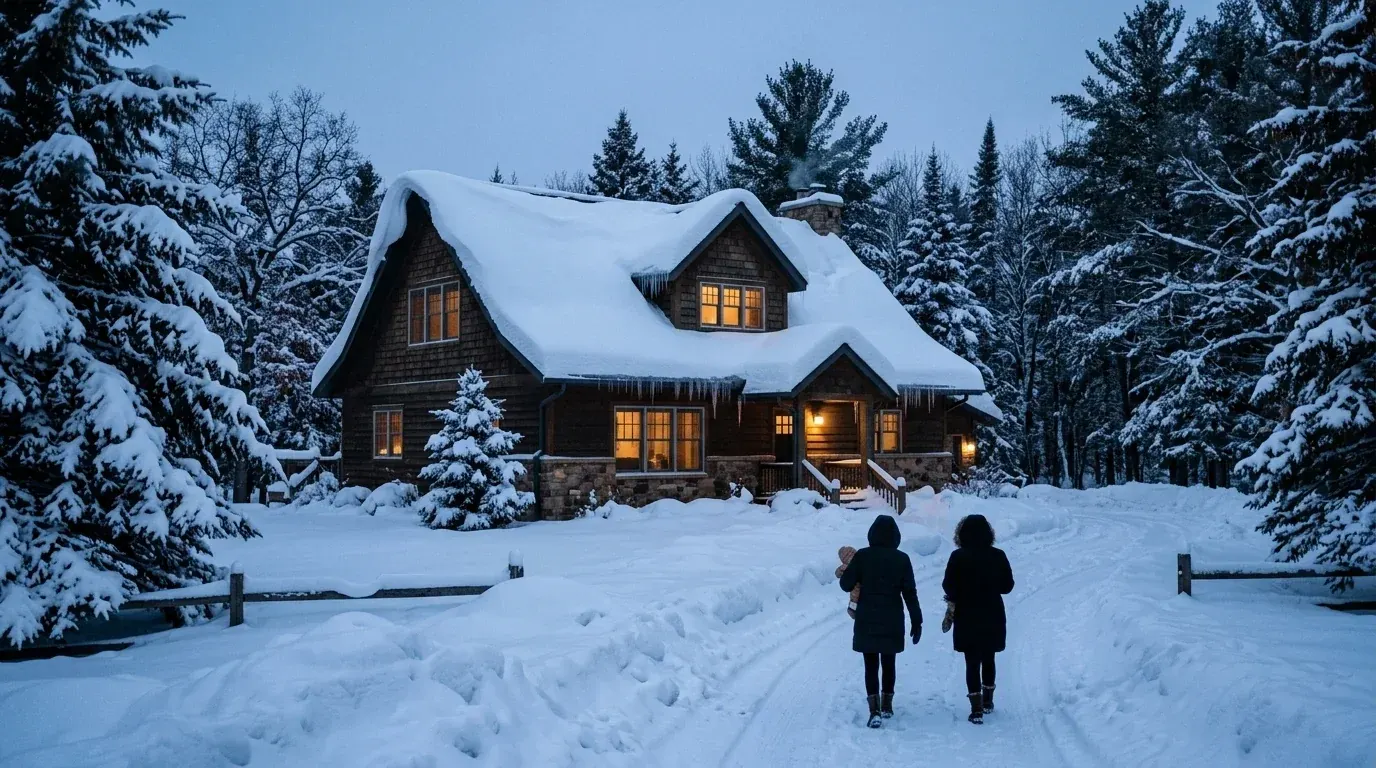
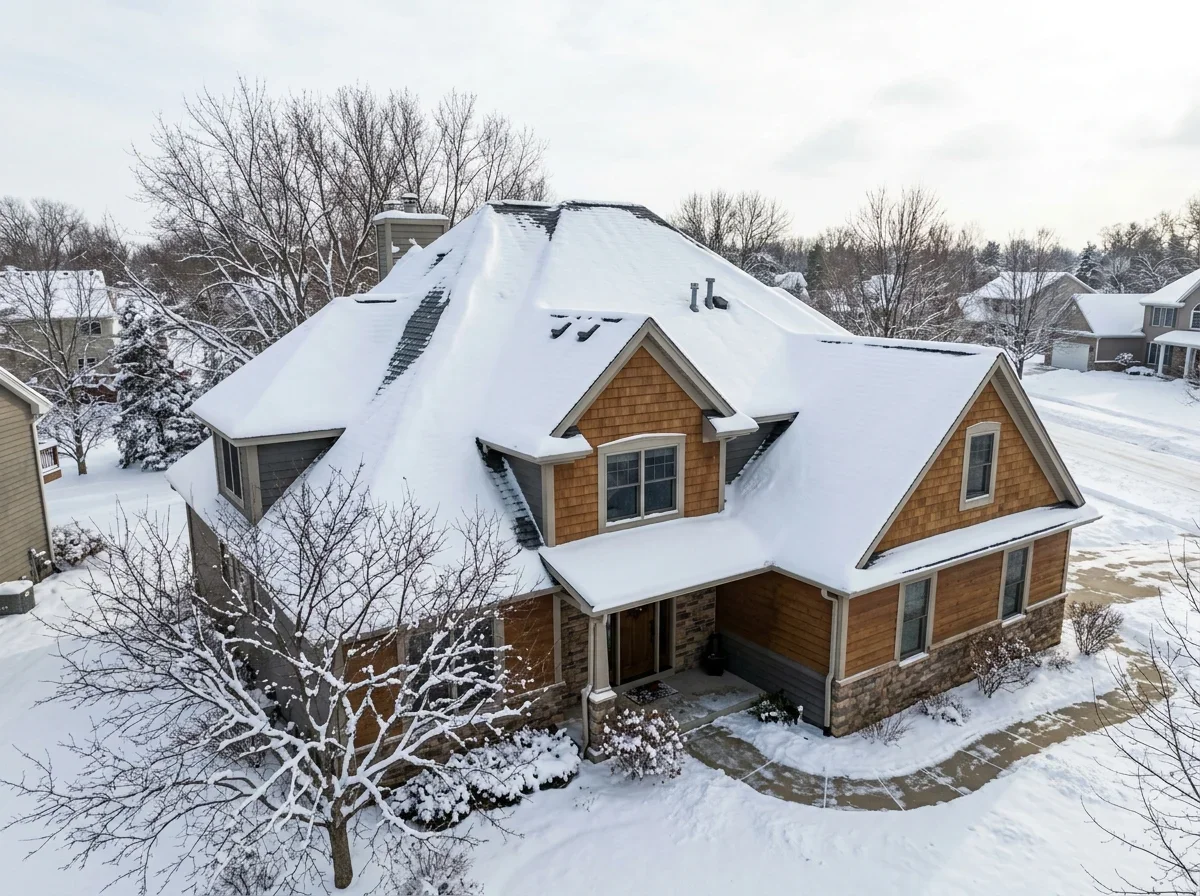
A snow-covered pitched roof on a home in winter
Zone
Roof snow load
Counties clear of the line
Code reference
Zone 1 (north)
40 psf
22
SPS 321.02, Figure 321.02
Zone 2 (south)
30 psf
29
SPS 321.02, Figure 321.02
Another 21 counties lie on the zone line, which brings the total to 72.[1]
This is a design load for roof framing, not a snow depth.
The code requires roofs to be designed and built to support the minimum snow loads on the zone map. It treats those loads as acting vertically over the roof area projected onto a horizontal plane.[3] The load can also be reduced for roof slopes greater than 30 degrees by applying a slope factor, which confirms the number is a design value and not a forecast.[5]
Counties sorted into Zone 1 and Zone 2
The line runs roughly east to west across the state, with Zone 1 to the north and Zone 2 to the south.[1]
Figure 321.02 is the code's "Zone Map for Roof Loads," and it is the document that fixes the zone.[4]
Side by side
Zone 1 versus Zone 2
Zone 1 (north)
40 psf
22 counties clear of the line
vs
Zone 2 (south)
30 psf
29 counties clear of the line
Zone 1 counties (40 psf)
These 22 counties are clear of the line: Ashland, Barron, Bayfield, Burnett, Chippewa, Douglas, Florence, Forest, Iron, Langlade, Lincoln, Marathon, Marinette, Menominee, Oneida, Polk, Price, Rusk, Sawyer, Taylor, Vilas and Washburn.[1]
Zone 2 counties (30 psf)
These 29 counties are clear of the line: Calumet, Columbia, Crawford, Dane, Dodge, Fond du Lac, Grant, Green, Green Lake, Iowa, Jefferson, Kenosha, Kewaunee, La Crosse, Lafayette, Manitowoc, Marquette, Milwaukee, Monroe, Ozaukee, Racine, Richland, Rock, Sauk, Sheboygan, Vernon, Walworth, Washington and Waukesha.[1]
The full county-by-county table, with a zone for every county, renders from the same data on this page.
Why some counties tell builders to ask the inspector
Figure 321.02 is a scanned map, and its boundary does not follow county lines cleanly.[1] A county touching the line can have its edge in one zone and the rest in the other.
Check with the city or your building inspector to confirm which requirement applies to your lot.
These 21 counties are on the line. For each, ask the county or municipal building inspector which zone your lot is in:
Adams, Brown, Buffalo, Door, Juneau, Outagamie, Pepin, Pierce, Trempealeau, Waushara and Winnebago (mapped mostly as Zone 2)
Clark, Dunn, Eau Claire, Oconto, Portage, Shawano, St. Croix, Waupaca and Wood (mapped mostly as Zone 1)
Jackson, where the line runs through the county and the zone is split
The mapped zone for each is a starting point only. A lot near the line deserves a direct answer from the inspector.
What the zone number controls on a roof or addition
The zone number is an input for whoever designs or builds the roof framing. It matters for new construction, additions, garages, porches and structural alterations. It is not a trigger for snow removal.
The Uniform Dwelling Code requires roofs to carry the minimum load on the zone map.[3] DSPS commentary adds that drifting or sliding snow may call for additional design consideration, so the mapped number is not always the whole answer for a given roof.[6]
The designer or builder sets the design load for your structure, and the local inspector approves it.
Online tools can confuse this. Roof loads and ground snow loads are different quantities, so a calculator showing a higher ground value is not necessarily contradicting the 30 or 40 psf in the code.[3]
Pro tip
Ask your builder or truss supplier which zone they used before the permit is filed.
Badger State Pros
Ask your builder or truss supplier which zone they used before the permit is filed. For permit rules by city, see the Wisconsin building permits by city page.
No. Wisconsin has no county frost-depth table, and one statewide rule applies everywhere.[2]
Under SPS 321.16(1)(a), footings and foundations go below the frost penetration level or at least 48 inches below adjacent grade, whichever is deeper.[2] A local inspector can ask for more, so ask the building inspector instead of assuming a county figure.