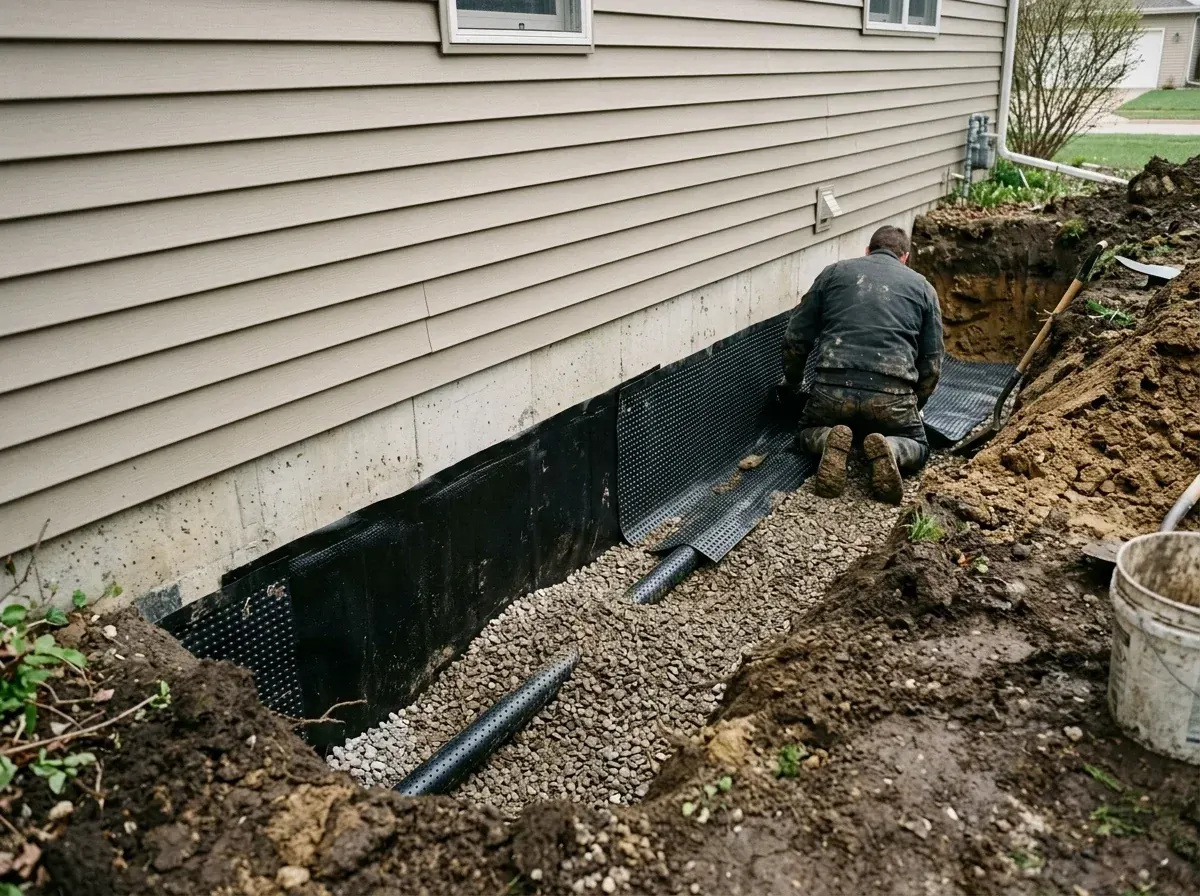
Permit rules for waterproofing a basement in Wisconsin
It depends on your city. Of the 30 largest, three name basement waterproofing in their permit pages, and all three say yes: Oak Creek, Sun Prairie and Fitchburg. For the other 27, check with the city permit desk before you start.
| Basement waterproofing permit | Cities (of 30) |
|---|---|
| Yes | 3 (Oak Creek, Sun Prairie, Fitchburg) |
| Not named, check with the city | 27 |
| No | 0 |
Each city's own pages were read, and the last check was October 2026. City rows are ranked using U.S. Census Bureau Vintage 2025 population estimates.[1] Milwaukee, Madison and Racine are all in the "check with the city" group.
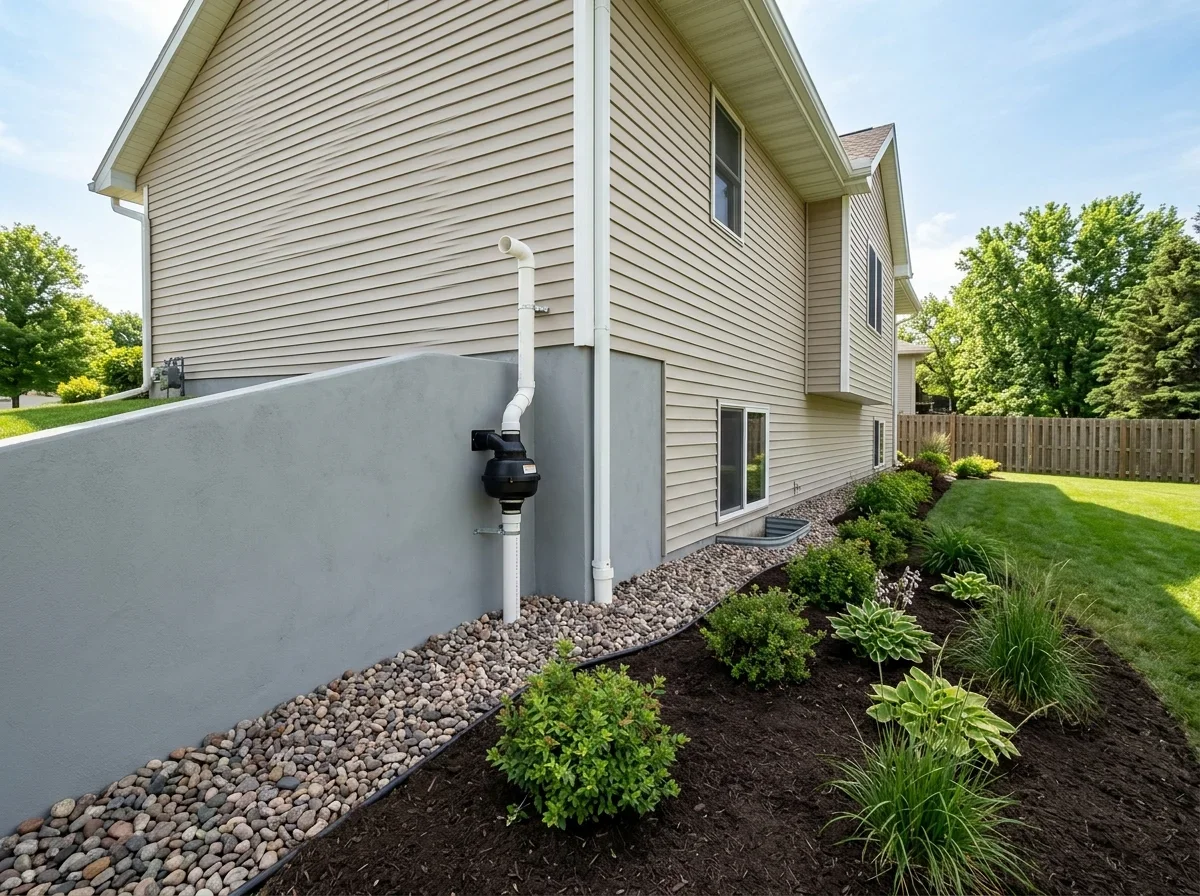
A city that does not name the job has not said no. It means its permit list does not say.
What the three "yes" cities say
Fitchburg lists basement waterproofing among the projects that need a permit. It also tells residents to contact Building Inspection when they are unsure whether a permit applies.[9] Sun Prairie requires a permit for drain-tile and basement-drainage-system installation, and says permits and inspections verify compliance with statewide statutes and city ordinances.[10]
Oak Creek is the third.
Its details are on the Oak Creek permit page, and the Sun Prairie and Fitchburg pages cover the other two.
Ask about the scope of work
A waterproofing job often bundles several kinds of work, and a city may treat them differently. Ask the building inspection department about each piece you plan to do.
| Piece of the job | What the data says |
|---|---|
| Basement waterproofing, named as a job | Permit required in Fitchburg and Oak Creek |
| Drain tile or drainage system | Permit required in Sun Prairie; elsewhere, check with the city |
| Crack sealing or sealant | Check with the city |
| Exterior excavation | Check with the city |
| Sump pump wiring | Check with the city; electrical work needs electrical credentials |
For any other city, start at the permit data page, which links each city's building department.
State footing and foundation depth rules
Wisconsin sets one footing rule for the whole state. Footings and foundations, including those for landings and stoops, go below the frost penetration level or at least 48 inches below adjacent grade, whichever is deeper.[2] There is no county frost-depth table.
That matters when a contractor proposes digging along the outside of your foundation.
Excavation that reaches the footing is working next to the part of the house the rule governs. Footings also may not be placed on frozen material.[2]
The rule has exceptions. Footings may bear directly on bedrock less than 48 inches down if the rock is cleaned of earth, clay in crevices is removed to a set depth, and provisions prevent water collecting along the foundation.[2] Properly designed frost-protected shallow foundations are also allowed for one- and two-family homes.[11]
The state inspection checklist adds minimum footing dimensions: 4 inches on each side of the foundation wall and 8 inches of depth.[12] A local inspector can ask for more than 48 inches, so ask your building inspector before assuming a number.
The frost depth guide covers the rule in full.
Radon risk by Wisconsin county
Radon is the one basement topic with a county map. The EPA's 1993 radon zone map places all 72 Wisconsin counties in Zone 1 or Zone 2.[3]
| EPA zone (1993 map) | Predicted average indoor level | Wisconsin counties |
|---|---|---|
| Zone 1 (highest potential) | Greater than 4 pCi/L | 28 |
| Zone 2 (moderate potential) | 2 to 4 pCi/L | 44 |
Zone 1 includes Dane, Waukesha, Rock, Washington, Walworth, Fond du Lac, Marathon, Portage and Jefferson, among others. Zone 2 includes Milwaukee, Racine, Kenosha, Brown, Outagamie, Winnebago and La Crosse.[3]
Side by side
EPA radon zones in Wisconsin
Zone 1
- Greater than 4 pCi/L
- 28 counties
- Includes Dane and Waukesha
Zone 2
- 2 to 4 pCi/L
- 44 counties
- Includes Milwaukee and Racine
Test your own home
The map predicts a county average and says nothing about one house. The EPA says all homes should be tested, regardless of zone designation.[3] It recommends fixing a home at 4 pCi/L or higher and considering a fix between 2 and 4 pCi/L.[4]
The Wisconsin Department of Health Services publishes radon test results and program information.[5][6][7]
For test kits and mitigation rules, see the radon guide.
No state license required for basement waterproofing
DSPS does not list a state license for basement waterproofing or foundation repair. The Department of Safety and Professional Services A-Z Professions List names 233 credentials and has no entry for this trade (checked October 2026).[8]
That does not mean no rules apply.
A city can still require its own permit. A contractor who pulls a building permit for a one- or two-family dwelling needs the Dwelling Contractor and Dwelling Contractor Qualifier credentials (SPS 305.31).[8] Work that touches plumbing, electrical wiring or HVAC equipment needs those trades' credentials.[8]
Wisconsin law also protects consumers who buy basement-waterproofing services and places requirements on sellers under Wisconsin Administrative Code ATCP 110.09.[13] The Department of Agriculture, Trade and Consumer Protection (DATCP) publishes a consumer page on the topic.
Check any credential a contractor claims with the DSPS license lookup. The dwelling contractor license page explains the credentials above.
Finding a waterproofing contractor in Wisconsin
Sort your question first, then pick the exit:
- Permit question: call your city building inspection department, or start from the permit data page.
- Radon: use the radon guide and test your own home.
- Footing or foundation work: read the Uniform Dwelling Code guide and ask your building inspector.
- The repair itself: browse Badger Basements, the sister directory for Wisconsin basement waterproofing.
This site lists no businesses and grades none.
The city or your building inspector has the final word on what your project needs.
Quick answers
Do I need a permit to waterproof a basement in Wisconsin?
It depends on your city. Oak Creek, Sun Prairie and Fitchburg say yes, and the other 27 cities checked don't name it, so check with the city.
Does Wisconsin require a state license for basement waterproofing?
DSPS does not list a state license for this trade, but a city can still require a permit and some credentials apply to related work.
How deep must footings be in Wisconsin?
Below the frost penetration level or at least 48 inches below adjacent grade, whichever is deeper.
Should I test for radon if my county is in Zone 2?
Yes. The EPA says all homes should be tested regardless of zone designation.
Sources
- U.S. Census Bureau. "City and town population totals, Wisconsin, Vintage 2025." https://www2.census.gov/programs-surveys/popest/datasets/2020-2025/cities/totals/sub-est2025_55.csv. Accessed October 17, 2026.
- Wisconsin Legislature. "Wisconsin Administrative Code, SPS 321.16 (Footings and foundations)." https://docs.legis.wisconsin.gov/document/administrativecode/SPS%20321.16. Accessed October 17, 2026.
- U.S. Environmental Protection Agency. "Wisconsin: EPA Map of Radon Zones (1993 map)." https://www.epa.gov/sites/default/files/2014-08/documents/wisconsin.pdf. Accessed October 17, 2026.
- U.S. Environmental Protection Agency. "EPA Map of Radon Zones." https://www.epa.gov/radon/epa-map-radon-zones. Accessed October 17, 2026.
- Wisconsin Department of Health Services. "Radon in Wisconsin (DHS)." https://www.dhs.wisconsin.gov/radon/index.htm. Accessed October 17, 2026.
- Wisconsin Department of Health Services. "Radon in Wisconsin (DHS)." https://www.dhs.wisconsin.gov/radon/radon-results.htm. Accessed October 17, 2026.
- Wisconsin Department of Health Services. "Radon in Wisconsin (DHS)." https://dhsgis.wi.gov/dhs/radon/. Accessed October 17, 2026.
- Wisconsin Department of Safety and Professional Services. "DSPS A-Z Professions List." https://dsps.wi.gov/a-z-professions-list/. Accessed October 17, 2026.
- City of Fitchburg, Wisconsin. "Permit Requirements." http://www.fitchburgwi.gov/157/Permit-Requirements. Accessed October 17, 2026.
- City of Sun Prairie, Wisconsin. "Building Permit." https://cityofsunprairie.com/222/Building-Permit. Accessed October 17, 2026.
- Wisconsin Department of Safety and Professional Services, Division of Industry Services. "DIVISION OF INDUSTRY SERVICES Quarterly Newsletter." https://dsps.wi.gov/MediaFileLocation/uyijnefh/2025_springnewsletter.pdf. Accessed October 17, 2026.
- Wisconsin Department of Safety and Professional Services. "Inspection Checklist for Typical One and Two Family Dwellings." https://dsps.wi.gov/a-z-programs-list/udc/forms/inspection-checklist/. Accessed October 17, 2026.
- Wisconsin Department of Agriculture, Trade and Consumer Protection. "Home Basement Waterproofing." https://datcp.wi.gov/Pages/Publications/BasementWaterproofing198.aspx. Accessed October 17, 2026.