What is the frost depth in Wisconsin?
Under SPS 321.16(1)(a), footings and foundations must sit below the frost penetration level or at least 48 inches below adjacent grade, whichever is deeper.[1] That is a two-part test, and the deeper answer wins.
The 48 inches is a floor.
The rule names footings for landings and stoops specifically.[2] A small stoop is not exempt. The same goes for deck footings, which have their own page in our Wisconsin deck code guide.
"Adjacent grade" means the ground next to the footing. If the grade slopes or will change, ask the inspector how they want the depth measured on your lot.
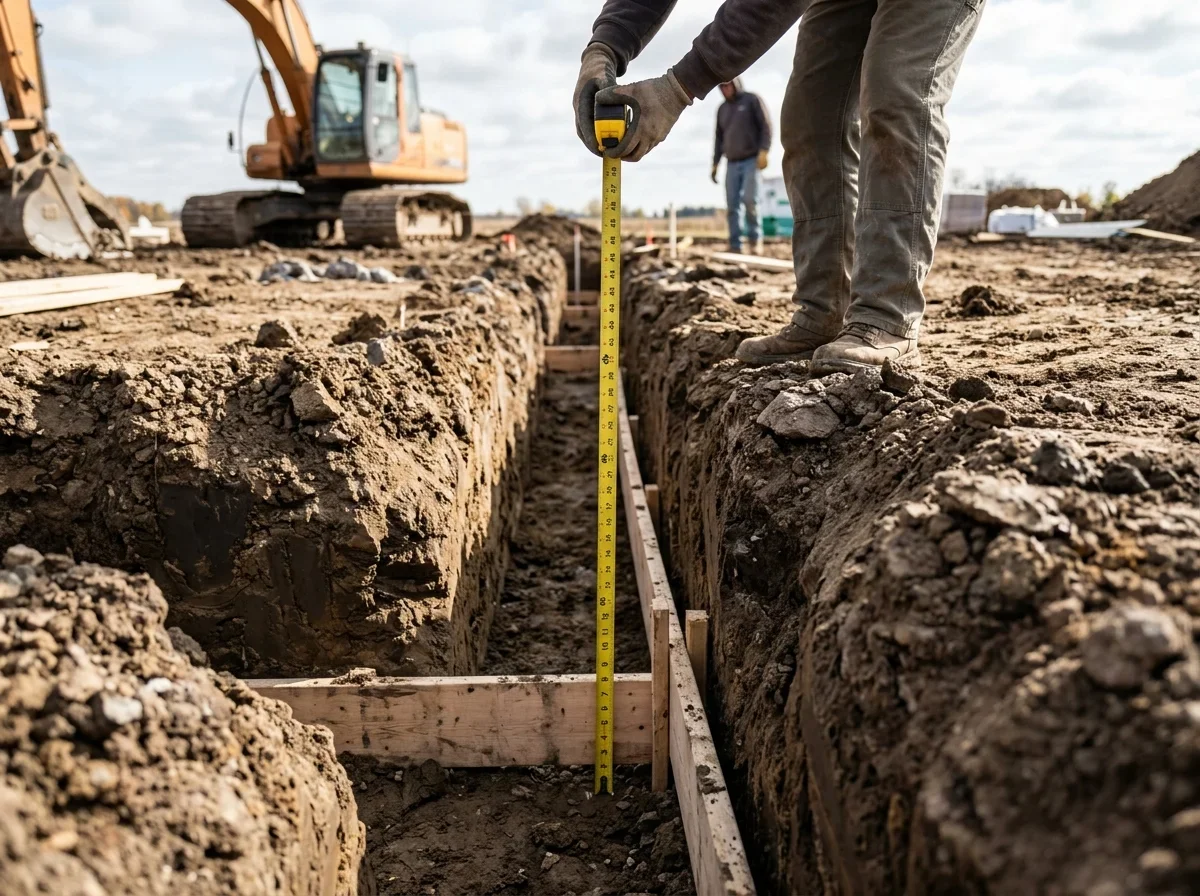
DSPS, the Wisconsin Department of Safety and Professional Services, describes SPS 321.16 as generally requiring a 48-inch footing depth to prevent frost damage, with specified alternatives such as frost-protected shallow foundations.[4] For the wider code that governs one- and two-family homes, see the Uniform Dwelling Code guide.
| Situation | What SPS 321.16 says |
|---|---|
| Standard footing depth | Below frost penetration or at least 48 inches below adjacent grade, whichever is deeper |
| Frozen material | Footings may not be placed on it |
| Bedrock less than 48 inches down | Footing may bear directly on rock if conditions are met |
Why no county frost depth table was written
Because the state did not write one.
Wisconsin sets a single rule that applies everywhere, and the code text you can read at the Wisconsin Legislature's site contains no county or regional depth figures.[1] That answers the question about southern Wisconsin too. The same rule applies, with no separate southern number.
If you find a county-specific figure online, treat it as informal advice. The local building inspector can ask for more than the state minimum, so the useful question is how your municipality applies the rule to your lot.[1]
The DSPS inspection checklist also directs officials to verify frost depth at the site, including at basement walkouts.[3] To find your municipality's contact, start with the permit table.
Footings on frozen ground or bedrock
Not on frozen ground. SPS 321.16(1)(b) says footings may not be placed on frozen material.[1]
A trench that is deep enough still fails if the bottom is frozen when the concrete goes in.
The bedrock exception
Bedrock is different. Under SPS 321.16(2)(c), a footing may bear directly on bedrock less than 48 inches below adjacent grade if three things are true:[1]
- The rock is cleaned of all earth.
- Clay in crevices is removed to the level of frost penetration or 1.5 times the crevice width, whichever is less.
- Provisions prevent water from collecting along the foundation.
This matters most where rock sits close to the surface.
Ask the inspector what they want to see before you rely on the exception.
Pro tip
Check the bottom of the trench for frost on the morning of the pour, since a deep trench with a frozen base still fails.
Questions to raise with the building inspector before digging
Call before you dig. Three questions cover most of it:
- Does this jurisdiction want a depth beyond 48 inches on my lot, and how should it be measured from adjacent grade?
- When should the inspector see the excavation, given frozen ground or rock at the bottom, and what must be visible and unfrozen at that point?
- Are stoops and landings handled the same way as the main foundation, and if I hit bedrock, what documentation do you want?
The city or the building inspector has the final word on how the rule applies to your site.
Look up your municipality in the permit table, and see the concrete and flatwork guide for the wider picture. If you need a crew to pour, Badger Flatwork covers concrete statewide.
Quick answers
What is the minimum footing depth in Wisconsin?
Footings must sit below frost penetration or at least 48 inches below adjacent grade, whichever is deeper.
Is there a different frost depth for southern Wisconsin?
No. The state rule has no county or regional depth figures, so the same rule applies.
Can a footing be placed on frozen ground?
No. SPS 321.16(1)(b) says footings may not be placed on frozen material.
Sources
- Wisconsin Legislature. "Wisconsin Administrative Code, SPS 321.16 (Footings and foundations)." https://docs.legis.wisconsin.gov/document/administrativecode/SPS%20321.16. Accessed October 17, 2026.
- Wisconsin Legislature. "SPS 321.16 — Frost protection." https://docs.legis.wisconsin.gov/code/admin_code/sps/safety_and_buildings_and_environment/320_325/321/iv/16. Accessed October 17, 2026.
- Wisconsin Department of Safety and Professional Services. "Inspection Checklist for Typical One and Two Family Dwellings." https://dsps.wi.gov/a-z-programs-list/udc/forms/inspection-checklist/. Accessed October 17, 2026.
- Wisconsin Department of Safety and Professional Services. "Chapter SPS 321 Commentary." https://dsps.wi.gov/MediaFileLocation/bkmk4r0t/sps-321-commentary.pdf. Accessed October 17, 2026.