Footing depth required for a Wisconsin deck
Deck footings go below the frost penetration level or at least 48 inches below adjacent grade, whichever is deeper. That is SPS 321.16(1)(a) of the Wisconsin Administrative Code, and it applies statewide.[1] The rule names footings for landings and stoops too, so the small landing at the bottom of your stairs needs the same depth as the deck itself.[5]
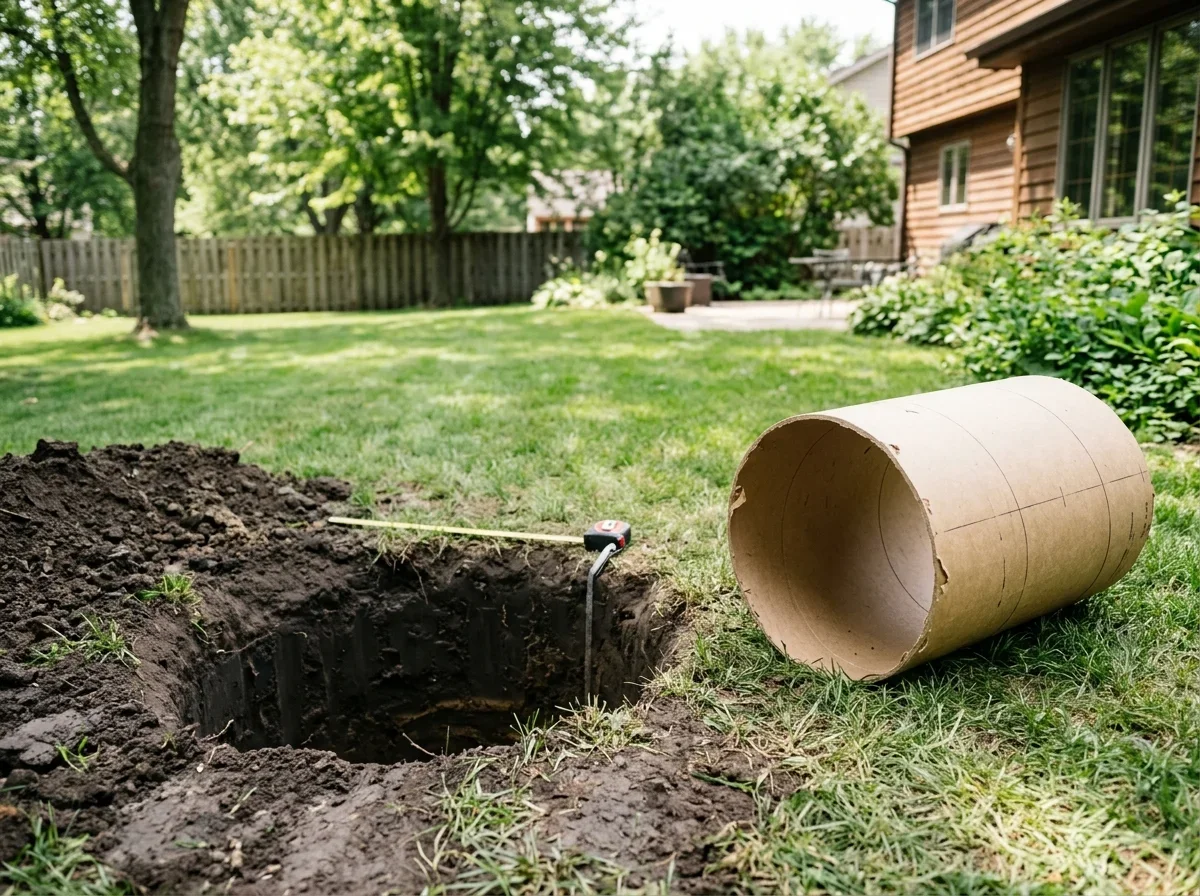
Wisconsin publishes no county frost-depth table. One rule applies everywhere, and 48 inches is the number to design to.
A local inspector can ask for more, so ask the building inspector instead of assuming a county figure. Our frost depth guide covers the rule in more detail.
Frozen ground and bedrock
Footings may not be placed on frozen material.[1] That matters if you dig in late fall or early spring, when the top layer can be solid.
Bedrock is the one listed exception. Under SPS 321.16(2)(c), a footing may bear directly on bedrock less than 48 inches down if three things are true:[1]
- The rock is cleaned of all earth.
- Clay in crevices is removed to the level of frost penetration or 1.5 times the crevice width, whichever is less.
- Provisions prevent water from collecting along the foundation.
If you hit rock at 30 inches, call the inspector before you pour anything.
Depth
Footing depth versus rock depth
Ground level
- 30 inchesRock found in the example
- 48 inchesMinimum depth below adjacent grade
Railing and ledger rules for Wisconsin decks
Ask your local building inspector for the current requirements on railing height, baluster spacing and ledger attachment. The state sources cited on this page do not state those figures. A wrong guard height is the sort of mistake that fails an inspection.
Plenty of web pages repeat a railing number with no section cited. Do not rely on one.
Read the current text of SPS 321 on the Wisconsin Legislature's administrative code site.
Our Uniform Dwelling Code overview explains what it covers and who enforces it.
Then take your drawing to the city or the building inspector. Ask which guard height, spacing and ledger details they want to see on the plans. Ask before you buy lumber.
Pro tip
Bring your drawing to the city and ask which guard height, spacing and ledger details it wants on the plans before you buy lumber.
Permit requirements vary by city
It depends on the city. Among the 30 largest cities by Census Bureau Vintage 2025 estimates[2], the answers split like this:
| Deck permit answer | Cities |
|---|---|
| Yes | 15 |
| Depends | 6 |
| No | 0 |
| Not confirmed | 9 |
The "depends" cities attach conditions, and the permit question turns on those conditions.
Cities that say yes
Madison, Green Bay, Waukesha, La Crosse, Fond du Lac, Brookfield, New Berlin, Sun Prairie, Oak Creek, Franklin, Manitowoc, Neenah, Superior, Stevens Point and Muskego all answer yes for a deck.
A "yes" can still carry carve-outs for repair work, so read the city's own page before you assume a like-for-like board swap is exempt. Start with Madison, Green Bay or Waukesha if you live there.
Cities that say it depends
Racine, Appleton, Eau Claire, Oshkosh, Fitchburg and West Bend fall here. The answer turns on the details of the deck.
Call with the address, size, height and whether it is attached or freestanding. The pages for Racine, Oshkosh and Fitchburg have more.
Cities where deck rules are unclear
For Milwaukee, Kenosha, Janesville, West Allis, Sheboygan, Wauwatosa, Wausau, Greenfield and Beloit, check with the city. The city page for each is linked in our permit table. Smaller towns and villages are not in the matrix at all, so ask your own building department.
Treat the matrix as a compilation of municipal pages, not a ruling.
The city has the final word.
Owner-builders and the deck contractor credential
You can, if you own the house and live in it. An owner who lives or will live in the dwelling and applies for the permit is exempt from the contractor credential, under Wis. Stat. 101.654(1)(b).[4]
Contractors are different. For one- and two-family dwelling permits, they generally must hold a Dwelling Contractor certification or engage a certified Dwelling Contractor Qualifier (DCQ).[6]
The Dwelling Contractor credential is held through a certificate of financial responsibility, which is valid for one year. It requires a bond of at least $25,000 or general liability insurance of at least $250,000 per occurrence.[3]
It is a permit-pulling credential, not a trade license. It does not say which trades may work on your deck, only who may obtain the building permit.[3]
Before you hire, verify the credential with the Department of Safety and Professional Services (DSPS). Our guide to looking up a Wisconsin contractor license walks through the search, and the dwelling contractor license page explains the qualifier and certification.
If you need a pro for the footings themselves, concrete footing contractors on Badger Flatwork are one place to start. Our concrete and flatwork guide covers the frost rules and permits behind that work.
Key takeaways
- Footings go below frost or at least 48 inches below adjacent grade, whichever is deeper
- No footing may sit on frozen material
- Owner-occupants are exempt from the contractor credential
- Ask the city for railing, ledger and permit details
Footings are the first thing inspected
The footings come first. The depth rule sits in SPS 321.16, so the inspector will want to see the holes before concrete goes in.[1]
Ask the city which inspections it schedules and when, because the stages differ by municipality. Keep the work open and accessible until each inspection is done.
Use this as a pre-inspection checklist, built only from the cited rules:
- Every footing, including those under landings and stoops, reaches below frost or at least 48 inches below adjacent grade, whichever is deeper.[5]
- No footing sits on frozen material.[1]
- Any footing bearing on bedrock meets all three conditions of SPS 321.16(2)(c).[1]
- The permit applicant is an owner-occupant or a contractor with the right credential.[4][6]
Ledger, flashing, guard and stair details belong on the same list. Ask the city for its deck application or worksheet, since each office sets its own submittal items.
Ask also whether it wants a site plan, and whether zoning setbacks are reviewed separately from the building code. Those are local questions, and only the city can answer them.
Quick answers
How deep must a Wisconsin deck footing be?
Below the frost penetration level or at least 48 inches below adjacent grade, whichever is deeper.
Can I build my own deck?
Yes, if you own the house and live in it, and you apply for the permit yourself.
Can a footing sit on bedrock?
Yes, if the rock is cleaned of earth, crevice clay is removed, and water cannot collect along the foundation.
Who has the final word on a permit?
The city or your local building department.
Sources
- Wisconsin Legislature. "Wisconsin Administrative Code, SPS 321.16 (Footings and foundations)." https://docs.legis.wisconsin.gov/document/administrativecode/SPS%20321.16. Accessed October 17, 2026.
- U.S. Census Bureau. "City and town population totals, Wisconsin, Vintage 2025." https://www2.census.gov/programs-surveys/popest/datasets/2020-2025/cities/totals/sub-est2025_55.csv. Accessed October 17, 2026.
- Wisconsin Department of Safety and Professional Services. "Dwelling Contractor (DC) (DSPS)." https://dsps.wi.gov/a-z-professions-list/dwelling-contractor-dc/. Accessed October 17, 2026.
- Wisconsin Legislature. "Wis. Stat. 101.654; SPS 305.31." https://docs.legis.wisconsin.gov/document/statutes/101.654. Accessed October 17, 2026.
- Wisconsin Legislative Reference Bureau. "Wisconsin Administrative Code SPS 321.16 — Frost Protection." https://docs.legis.wisconsin.gov/code/admin_code/sps/safety_and_buildings_and_environment/320_325/321/iv/16. Accessed October 17, 2026.
- Wisconsin Department of Safety and Professional Services. "Dwelling Contractor Qualifier (DCQ)." https://dsps.wi.gov/a-z-professions-list/dwelling-contractor-qualifier-dcq/. Accessed October 17, 2026.