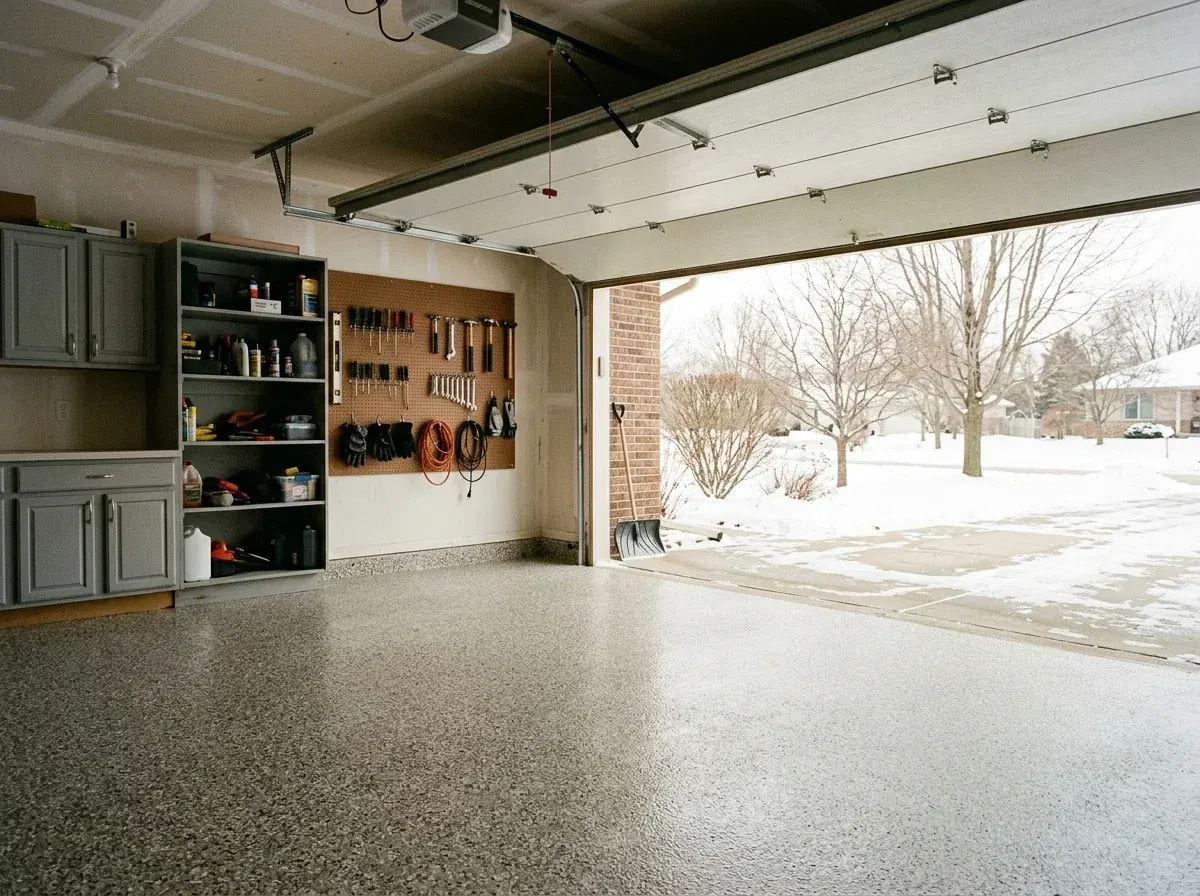
Reasons garage floor coatings fail in Wisconsin
Most failures start under the coating, not in it. Wisconsin's residential code generally calls for a vapor retarder beneath concrete floor slabs, but it specifically does not require one beneath an unconditioned attached garage slab.[2] That means moisture can migrate up through a garage slab more freely than through a basement or living-space slab.
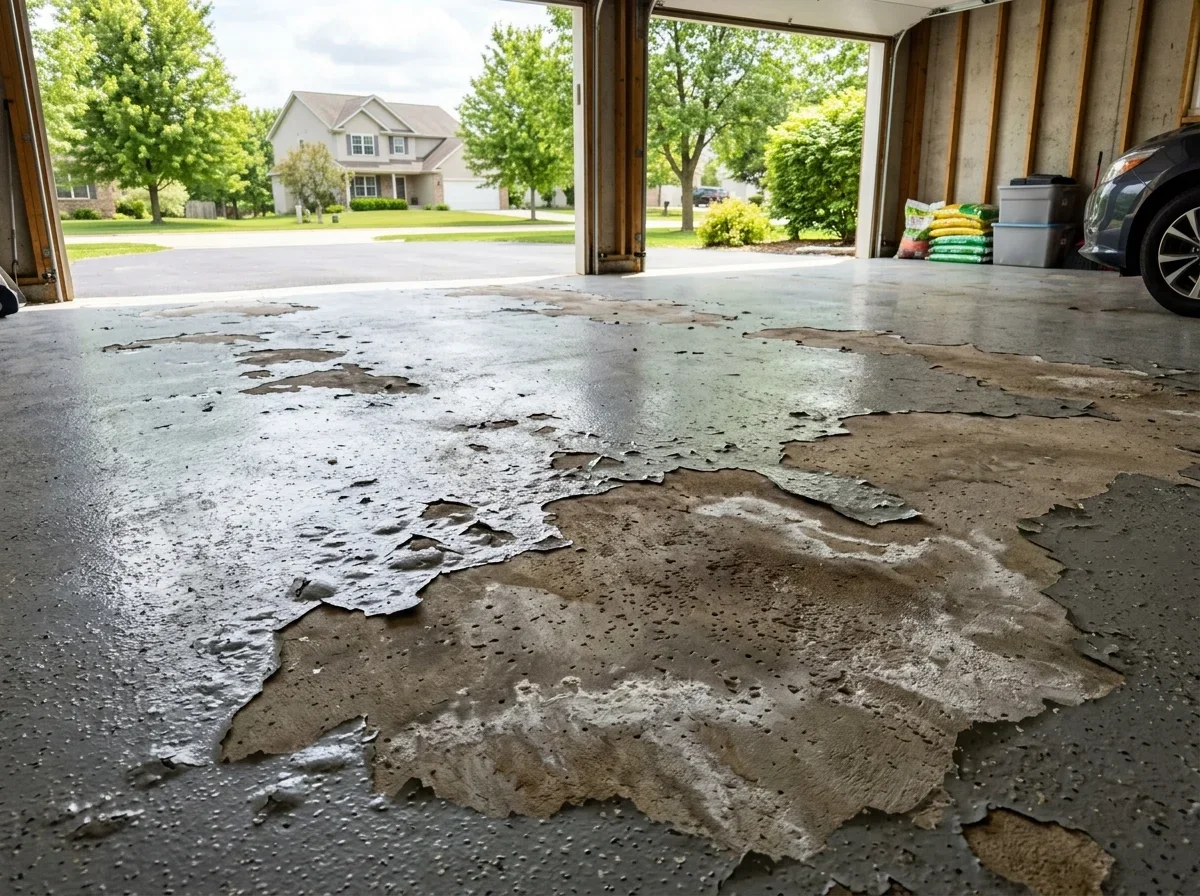
A film-forming coating such as epoxy sits on top of that slab and does not breathe. If vapor is moving upward, it has nowhere to go, and the coating becomes the weak point.
The usual result is blistering, peeling or sheets of delaminated film. The slab fails the coating, not the other way around.
What the white powder means
White powder or fuzzy deposits on bare concrete are rarely dirt. They are usually efflorescence, which is salt carried to the surface by moisture moving through the slab.[3]
If you see it, treat it as a sign that water is already traveling through the concrete. Sort out drainage and water entry before you think about a coating.
Salt and freeze-thaw
Winter adds a second load. Vehicles carry salty meltwater into the garage and park it over a cold slab.
Salty water can soak into concrete and worsen freeze-thaw damage and spalling. That's why patches over already-damaged concrete tend to be temporary.
A coating can hide those symptoms for a while without fixing their cause.
| What you see | What it usually means | What to do first |
|---|---|---|
| Blistering or peeling film | Vapor moving up through the slab | Test the slab for moisture |
| White powder on bare concrete | Efflorescence from moisture carrying salt | Sort out drainage and water entry |
| Spalling or crumbling surface | Salty water and freeze-thaw damage | Remove weak concrete and repair it |
Choosing a coating for a Wisconsin garage
Pick the slab check first and the product second. Preparation and moisture conditions decide how long a floor lasts far more than the name on the bucket.
Test the slab before you coat it
A surface that looks dry can still be passing a lot of vapor. ASTM F2170 is the standard for in-situ relative-humidity testing, and it places probes inside the slab so the reading reflects internal moisture rather than a surface impression.[3] In words, the process looks like this:
- Choose several test spots, including areas near the door, near cracks, along walls and in any damp or powdery patches.
- Have probe holes made in the slab at those spots, following the ASTM F2170 method.
- Let the probes reach equilibrium, then record the relative-humidity reading at each location.
- Get the results in writing, with locations marked, rather than a verbal assurance that the slab is fine.
Treat the result as a go or no-go step. A high reading means the slab needs attention before any film goes on it.
Pro tip
Ask for the moisture readings in writing with each test location marked, so you can compare them with what the installer promises.
Questions to put to an installer
Ask how the slab will be prepared. Diamond grinding or shot blasting opens a clean surface by removing weak concrete, and it is a better answer than acid etching alone.
Oil, salt, tire residue and loose concrete should be removed rather than coated over.
Side by side
Prep: what to hope for and what to question
Good answer
- Diamond grinding or shot blasting
- Weak concrete removed
- Oil, salt and residue cleaned off
Weak answer
- Acid etching alone
- Coating over loose concrete
- No mention of salt or oil
Ask what the written scope names. It should state the prep method, the moisture testing, how cracks and spalled spots will be repaired, and what the warranty covers and excludes.
A quote that leaves these out may be cheaper for a reason.
Epoxy, polyurea and polyaspartic
Epoxy, polyurea and polyaspartic systems all form a film, and each has trade-offs in cold installation, UV exposure and salt traffic. Compare them against your slab's moisture reading and your garage's conditions, not against advertised cure speed.
Cold garages also need longer cure times than many people expect. Keep vehicles off the floor longer than the minimum walk-on time.
Timing matters too. Coating in the warmer months, ahead of salt season, gives the floor time to cure before the first winter vehicles arrive.
What a coating does not fix
A coating will not cure active water pressure, a failed or missing vapor barrier, structural cracking or severe spalling. It also does not end winter work.
Sweep out heavy salt and grit, then rinse and squeegee the floor when temperatures allow. Don't leave salty slush to sit.
Does epoxy flooring need a state license in Wisconsin?
DSPS does not list a state license for garage floor coating. The trade does not appear on the Wisconsin Department of Safety and Professional Services A-Z Professions List, which names 233 credentials (checked October 2026).[1]
The building-related credentials on that list are Dwelling Contractor (DC), Dwelling Contractor Qualifier (DCQ) and Dwelling Contractor Restricted. Also listed are the electrical, plumbing, HVAC, sprinkler, elevator and manufactured-home credentials, Home Inspector, Landscape Architect, Utility Contractor and Pipelayer.[1]
Two limits are worth knowing. A city can still require its own permit, and a contractor who pulls a building permit for a one- or two-family dwelling needs the DC and DCQ credentials (SPS 305.31).[1]
Work that touches plumbing, electrical wiring or HVAC equipment needs those trades' credentials.[1]
With no license to check, vetting takes a different form. Ask for a certificate of liability insurance, a written warranty and a written scope, and read recent reviews.
If a floor drain, a new outlet or a heater is part of the job, confirm the credentials for that work with the DSPS license lookup. Your city's building department has the final word on whether a permit applies. The permit rules by city page links to each one.
If the slab itself is the problem, with cracks, heaving or broken sections, that is concrete work rather than coating work. The concrete and flatwork guide covers it.
Finding an epoxy floor pro in Wisconsin
Start with a pro who begins the conversation with the slab, not with a color chart.
A useful evaluation covers slab condition, moisture testing in several spots, salt contamination and freeze-thaw damage. It ends with the results in writing.
Fox Valley Epoxy is the sister directory for garage floor coating, and it is the place to go for pricing and installer questions. This page does not quote costs, since those depend on the slab, the system and the prep.
Bring the answers from this page with you:
- Where the moisture readings were taken, and what they were
- Whether the slab will be ground or blasted
- How cracks and spalls will be repaired
- What the warranty says about moisture-related peeling
An installer who can answer all four in writing is working from the slab, which is where a Wisconsin garage floor succeeds or fails.
Quick answers
Why does a garage floor coating peel in Wisconsin?
Often because moisture vapor moves up through the slab, and the Wisconsin code does not require a vapor retarder under an unconditioned attached garage slab. A film coating cannot breathe, so it blisters or peels.
What is the white powder on my garage concrete?
Usually efflorescence, which is salt carried to the surface by moisture moving through the slab. It signals that water is already traveling through the concrete.
Does garage floor coating need a state license in Wisconsin?
DSPS does not list a state license for it, but a city can still require a permit, and plumbing, electrical or HVAC work needs those trades' credentials.
Sources
- Wisconsin Department of Safety and Professional Services. "DSPS A-Z Professions List." https://dsps.wi.gov/a-z-professions-list/. Accessed October 17, 2026.
- Wisconsin Department of Safety and Professional Services. "UDC FAQs." https://dsps.wi.gov/MediaFileLocation/xxgcn5wh/archive_faqsps322.pdf. Accessed October 17, 2026.
- ASTM International. "Concrete Slab Moisture Testing: ASTM F2170." https://www.astm.org/f2170-19.html. Accessed October 17, 2026.